
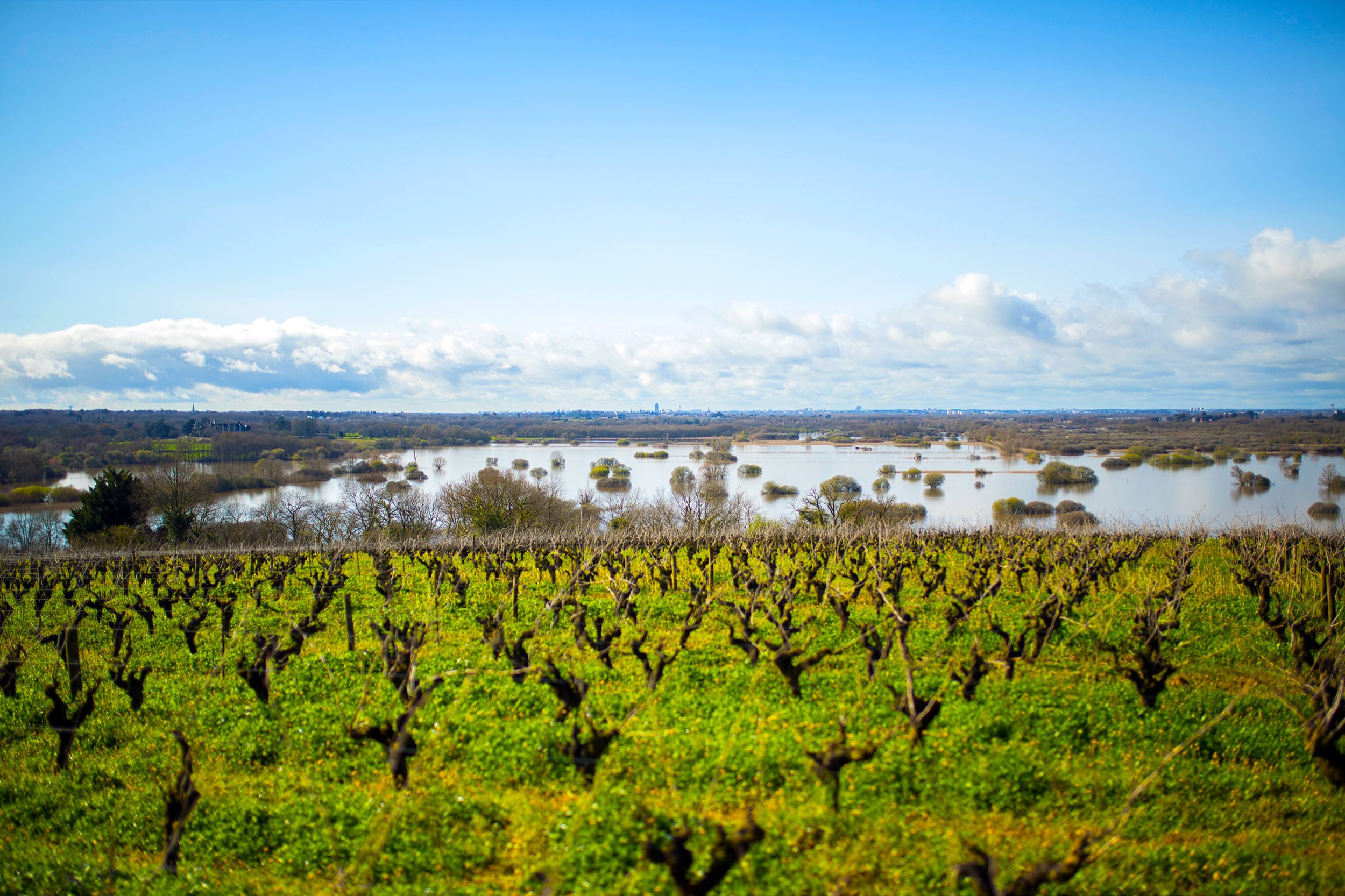
Domaine Luneau-Papin Loire Valley, France.
Established: 1976 from merging the family domaines of the Luneau and Papin estates begun in 17th + 18th centuries
Appellations:
AOC Muscadet de Sevre-et-Maine
Proprietor: Pierre Luneau-Papin
Winemaker: Pierre and Monique Luneau-Papin
Wine Making Overview: Hand harvest for all cuvees with spontaneous fermentation using only indigenous yeasts. Fermentation and maturation on fine lees in underground glass lined vats for most cuvees with no racking before bottling. Ageing on lees for 16 months for entry level cuvees up to more than 3 years for top cuvees.
Average Production: 15 000 dozen average/pa
Viticulture: Certified organic. Certified Biodynamic since 2019.
Vegan Friendly: Yes
Vineyard Area: 39ha
Vineyards: based in Le Landreau and Chapelle-Heulin
Clos des Noelles
La Claretiere
Les Pierres Blanches
La Butte de La Roche
Clos des Allees
Vine Density: 7000/ha several plots planted with their own massale selection vines
“Pierre-Marie and Marie Luneau are one of the most dynamic couples in the French vineyard. Their know-how on their 37 hectare vineyard and their expertise have no equal in the region. The work at the vineyard is carried out according to the principles of organic farming and biodynamics and the vintages are great gastronomic wines, whose evolution over time constitutes a model of their kind. Our tastings always place this estate at the top. ★★★★”
One of the leading domaines of the Nantais, Pierre Luneau-Papin, hails from a long line of vignerons. The Luneau family is well established in the region; their presence here may be traced as far back as the late 17th Century and Pierre Luneau is the thirteenth generation of his family to bear the name Pierre. Pierre and Monique, his wife, are the seventh generation of vignerons to run Domaine Luneau-Papin, which was founded by Pierre's forebears in the 18th Century.
Having studied at Briacé and gained experience with Emile Peynaud and Pascal Ribéreau-Gayon, both of the Faculty of Oenology at the University of Bordeaux, it is perhaps no surprise that Luneau-Papin is one of Muscadet's leading lights. In his immaculate winery, Pierre proceeds to vinify in small batches according to the origin of the fruit. The harvest is done by hand, also a rarity in the region, to avoid any oxidation before pressing. There is an immediate light débourbage (separation of juice from gross lees), then a 4-week fermentation at 20 degrees, followed by 16 months (or up to 21 months for some cuvées) of aging in stainless-steel vats on fine lees. This is the classic Muscadet-sur-lie process, where the wine is kept on its lees, with a fair amount of CO2 as protection, until bottling in the spring following the harvest. The only modern technique used here is macération pelliculaire (maceration of lightly crushed berries before pressing), which varies in proportion according to the cuvées.
The family estate now consists of approximately 40ha, with 38ha planted to Melon de Bourgogne located about 20 kilometres from Nantes itself. This is a landscape characterised by gently rolling vineyards and a remarkable variation of terroirs, which include micaschist, gneiss and schist and other rocks of volcanic origin, as well as the sandy soils that first spring to mind when thinking of the region. The vines have a good age, 45 years on average although some are well into their seventh decade. The wines produced at this estate are strikingly pure, with each cuvée expressing its unique soil-signature. They never fail to impress.
Muscadet La Grange
2022 From vines planted 1974 grown on mica-schist with a bedrock of schist in the village of Le Landreau. Hand harvested and aged on lees for 7 months. On the palate the wine is pure and well defined, complex and beautifully focused, with solid mid-palate depth, nice framing acids and very good length on the classy finish.
This cuvée, Pierre-Marie reliably informs me, is sourced from 12 hectares of vines planted in multiple parcels around the cellars in Landreau, the planting of which dates to 1974. The soils are micaschist and schist. It presents a nose of dried yellow peach, mirabelle and smoke. This is followed by a nicely polished style on the palate, being gently composed with a powdery phenolic backbone underneath a generous layer of white peach and apple, with modest but evident acidity, before it concludes with an appealingly bitter grip in the finish. Decent balance for the vintage. The alcohol on the label is 12%. 90/100 thewinedoctor.com Feb 2024
Muscadet La Grange 2024 - due mid-2026
From vines planted 1974 grown on mica-schist with a bedrock of schist in the village of Le Landreau close the estates cellars. Hand harvested then fermented with spontaneous alcoholic fermentation using indigenous yeasts. Aged in large oak casks, barrels, and underground tanks lined with concrete and glass tiles for 12 months without racking before bottling at the end of October 2025. On the palate the wine is pure and well defined, complex and beautifully focused, with solid mid-palate depth, nice framing acids and very good length on the classy finish.
2024 The 2024 Muscadet “La Grange” bottling from Luneau-Papin is made from fifty year-old vines and is aged for sixteen months on its fine lees prior to bottling. It offers up a deep, vibrant and complex bouquet of lemon, tart pear, lovely leesy tones, a fine base of wet stone minerality, a touch of briny ocean breeze and a topnote of dried flowers. On the palate the wine is crisp, complex and full-bodied, with a beautiful core of fruit, fine mineral drive and grip, impeccable balance and a long, precise and classy finish. I love the backend mineral grip this wine revels in. 2026-2045+. 93+/100 John Gilman, viewfromthecellar.com August 2026
2024 A wine from vines on schist and micaschist, ranging across several parcels in Landreau. It was vinified in subterranean cuve, foudres and barrels. It has a quite gorgeous nose, revealing punchy and slightly sour fruit, with a sense of freshness. The palate is textural and correct, with a supple and sour core of fruit, plenty of pithy substance, with phenolic grip and the vibrant acidity of this challenging vintage. It has a confidence to the finish, and on the whole this is a good result in 2024. One to drink young rather than committing to the cellar though. The alcohol is 12% on the label. 89/100 thewinedoctor.com August 2026
Muscadet Clos de L’Allee
…the Clos des Allées cuvée, in more recent years amended to Clos de L’Allée. This originates from the lieu-dit of the same name Le Landreau, the vines here planted in 1974 on a south-facing slope, the terroir underfoot comprising about 20 centimetres of soil over schist and mice schist. The vinification here is as expected, a pneumatic pressing followed by fermentation in subterranean glass-lied cuve and Italian terracotta amphorae, and the wine then remains on the lees until bottling the following summer. thewinedoctor.com
2023 Vines planted in 1974 in the village of Le Landreau. Weathered mica schist and gneiss rock from the Armorican Massif. Clos de l'Allée is a place steeped in history. 2.3 hectares in a single block bordered by paths, the historical boundaries of three late 18th-century lordships that gave rise to the village of Le Landreau. 75 owners were recorded according to Cassini's maps. This walled vineyard, the ancestral home of the Luneau family, is adjacent to the estate's cellars. Spontaneous alcoholic fermentation using indigenous yeasts. Aged in underground tanks lined with concrete and glass tiles for 16 months without racking before bottling in February 2025. Beautiful aromas, both expressive and detailed, with ripe fruit and plant aromas hinting at the textural suppleness and shimmering minerality that the mica-schist soil conveys to the silky very long palate. Always a favourite of ours returning in the beautiful 2023 vintage.
Long-term fans of this cuvée will remember the Clos de l’Allée as the one with the metallic green label; these days it has a rather more hip label design to match the rest of the Luneau-Papin range. Here the vines are on micaschist and gneiss around Le Landreau, and like others on the domaine they were planted by Pierre Luneau-Papin in 1974. Aromatically this feels more old-school than the rest of the portfolio, classic eye-popping Muscadet with notes of lime, thyme, green pepper and herbs. The palate is charming and fresh, with a supple texture, riven with lively herb and mint notes, but also a delightfully incisive acid backbone. An impressive construct, and I think this will develop in bottle very well, once it gets there anyway; here bottling has been delayed until March 2025. 92-94/100 thewinedoctor.com Feb 2025
2023 The 2023 Clos de l‘Allée single vineyard cuvée from Domaine Luneau-Papin is a beautiful bottle of Muscadet. These vines are planted on soils of mica schist and translate their underlying minerality stunningly well into the finished wine. The 2023 Clos de l‘Allée’s aromatic constellation delivers scents of a very refined blend of breadfruit, lemon, salty minerality, lovely leesy added complexity, dried flowers and a hint of menthol in the upper register. On the palate the wine is bright, complex and full-bodied, with a superb core of fruit, an outstanding foundation of minerality, excellent acids, fine focus and grip and a long, impeccably balanced and youthfully complex finish. Like any top flight Muscadet, the 2023 Clos de l‘Allée is already very easy to drink out of the blocks, but it is clearly still a young wine and has plenty more complexity to unfold if given some time in the cellar. 2026-2055+. 94+/100 John Gilman, viewfromthecellar.com August 2026
Muscadet Sur Lie Terre de Pierre
Vines planted in 1974 on one of the highest and most exposed sites in Muscadet, La Butte de la Roche (pictured above), in the village of Loroux-Bottereau. Here, the terroir is based on rare 500 million-year-old Serpentinite. The juice is cold-settled then fermented with native yeasts and matured on lees for 17 months without racking.
2020 No prizes for knowing this comes from the Butte de la Roche, the vines planted in red ochre soils over peridotite and serpentinite bedrock. The vinification and élevage were traditional, the bottling completed during the summer of 2021. It offers up scents of orange fruits on the nose, with lavender, verbena and crushed chalk. The palate shows a charming and relaxed texture, with a supple, sinewy, cohesive build, spiced with powdered chalk and orange zest, as well as an attractive core of acidity which keeps the palate and finish fresh. This should develop well, in the midterm at least. The alcohol is 12%. 92/100 thewinedoctor.com Feb 2024
Muscadet Excelsior Cru Communal Goulaine - SOLD OUT
From 80 year-old massale selection vines grown on schist and mica-schist at La Plécisière in the village of Chapelle-Heulin. The juice is cold-settled then fermented with native yeasts and matured on stirred lees for 36 months. Since 2011, Cru Communal is the new elite appellation in Muscadet. The wines must come from the designated terroir (in the case of Goulaine, schist) and spend a minimum of 17 months on lees. The finished wines are then tasted and certified by a regional panel before bottling. Serve as you would for a good white Burgundy.
2014 ‘Last tasted in late July 2016, around three months ahead of bottling, this leads with an intriguingly Chablis-like combination of struck flint, herbed chicken stock and fresh, seed-inflected lemon. A polished, sensationally savory midpalate suggests the introduction of mussel broth, leading to a long finish that awes with its diversity even as it tugs relentlessly at the salivary glands. Drink 2017-2028.’ (93-94) points, David Schildknecht, RobertParker.com, May 2017.